






 Brazil
 Colombia
 France
 Germany
 Italy
 Netherlands
 Portugal
 Spain
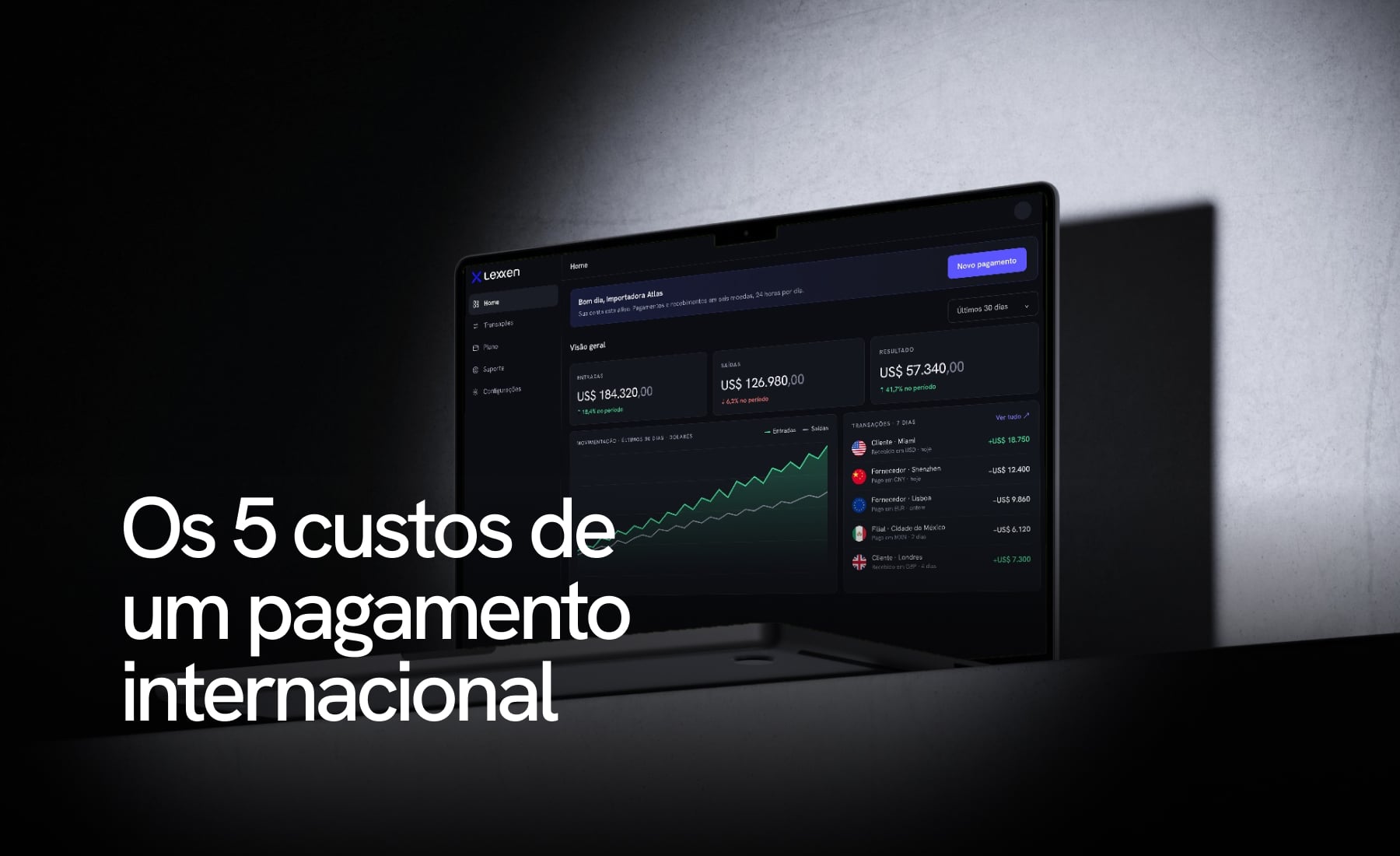
The real cost of an international payment in 2026
When a company sends or receives money from abroad, the cost is almost never in one place. One part shows up on the statement. The other part hides in the exchange rate, in the waiting time, and in the banks the money passes through along the way.
In this study, we break down what makes up that cost in 2026, show where it usually hides, and teach you how to calculate how much your company really pays.
The 5 costs of an international payment
1. Transfer fee. This is what the bank or platform charges to process the operation. It can be a flat fee or a percentage of the amount sent. Some institutions advertise it as "free," but that doesn't mean the operation has no other costs.
2. Banks along the way. In a traditional transfer, the money goes through intermediary banks, and each one can deduct a fee. The result is simple: your supplier receives less than you sent.
3. Exchange rate margin. The bank or platform rarely uses the day's reference rate. The difference between the two is a cost, even if it never appears as a line on the statement. In practice, it is usually the biggest part of what the company pays.
4. IOF (Brazil's tax on financial transactions). This is the tax on the operation. The rate depends on the type of operation, is set by decree, and has changed more than once in recent years. That's why you should always confirm the current rate with your accountant before setting the price of an import.
5. Receiver's fee. Some banks charge the recipient to accept a payment coming from abroad.
The cost that isn't on the invoice: time
A traditional international transfer can take 1 to 5 business days, and only moves during banking hours. In Europe, the local euro system can complete it in up to 1 business day.
Idle money has a price. The supplier waits before releasing the order, production is delayed, cash gets stuck and, sometimes, the commercial terms that were negotiated are lost.
Local instant payment methods, on the other hand, such as PIX in Brazil, SEPA Instant in Europe and SPEI in Mexico, complete in minutes and work 24 hours a day.
How to calculate the real cost in 3 steps
1. Write down how much left your account in reais, adding up all fees and taxes.
2. Write down how much the supplier received, in their currency.
3. Compare it with the commercial exchange rate on the day of the operation. The difference, as a percentage, is your real cost.
Do this calculation on your last three operations. Most companies are surprised by the result, because the advertised fee is only part of the total.
How Lexxen fits into this calculation
Lexxen is a global payments platform for companies, built to make every part of this cost visible and the path as short as possible:
- Cost on screen before you confirm. You see the rate, the fee and the final amount before executing. There is no charge that only shows up at the end.
- Local payment method on both ends. The payer uses the transfer their bank already uses. The receiver sees their usual currency in their account. With instant methods, the money arrives in minutes.
- Price per operation that drops with volume. The more your company moves per month, the lower the price, according to the tiers agreed in your contract.
- Everything in one place. Six currencies, the same balance and the same statement, including paying a supplier in China straight from PIX.
Behind the scenes, the money crosses countries as digital dollars (USDT or USDC), which work all day, including weekends. It is only the path: it is not an investment, and Lexxen does not promise yield or appreciation.
Want to know what your company would pay?
Tell us where the money leaves from and where it goes. You receive in writing the price, the timeline and the limits for your case.